

Equipment rental
Simultaneous Interpretation Equipment Rental
A complete simultaneous interpretation system: booths and consoles for the interpreters, a receiver with headphones for every listener, and the sound chain that connects them. Delivered, installed and operated by our own technicians.
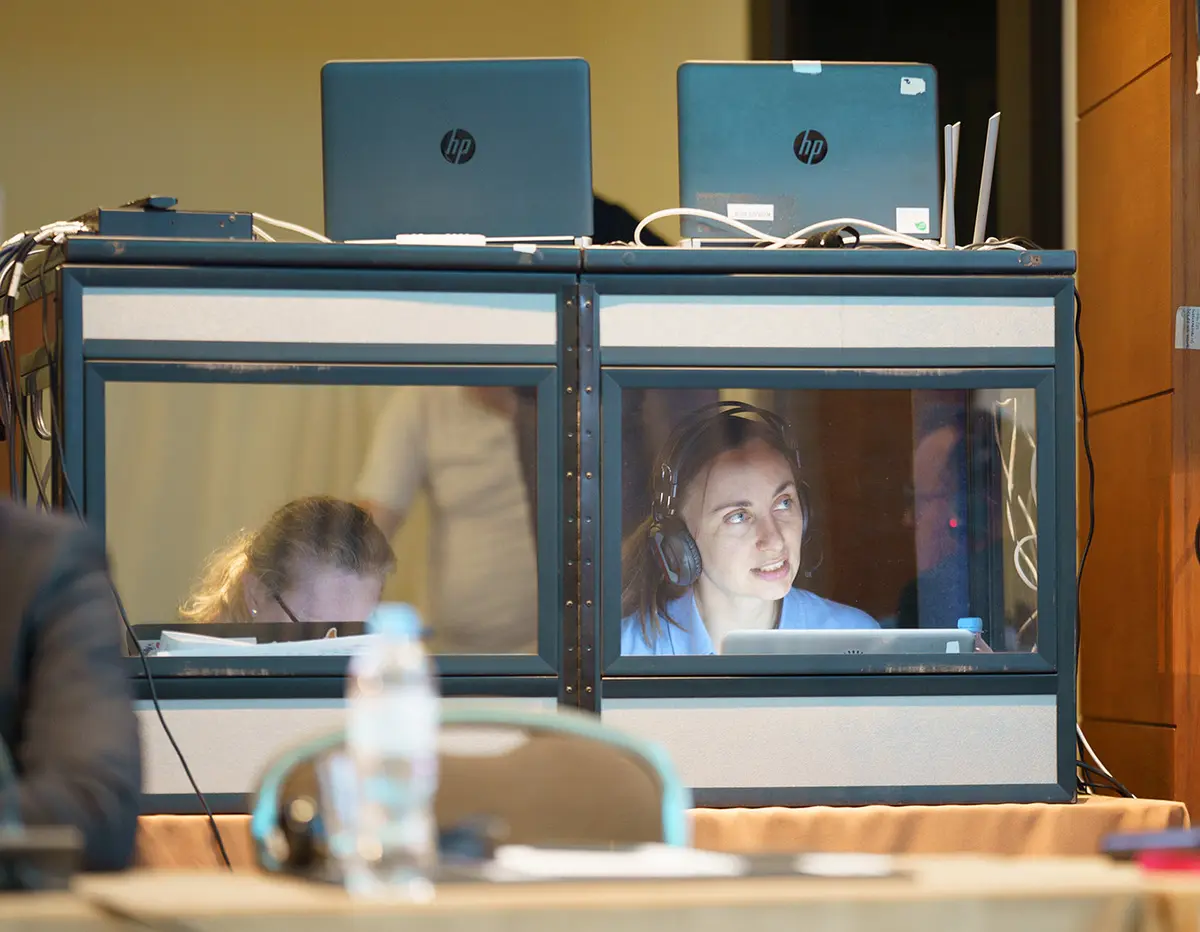
- 01ISO 4043 booths
- 02Up to 8 language channels
- 03Technician on site
For the interpreters
- Soundproof booths to ISO 4043, the standard institutional clients ask for, with their own ventilation and a clear view of the room.
- Interpreter consoles for switching channels, relay and handover between the two interpreters in the booth.
- Headsets and microphones matched to the consoles, so nothing has to be adapted on the day.
For the audience
- A receiver and headphones for every listener, in the quantity the room needs.
- Channel selection, so each participant picks the language they want to hear.
- Charging and handover cases, which keep the distribution before the session short.
The chain in between
- Transmitters and radiators sized to the hall, so coverage does not fall off at the back rows.
- Mixers and amplifiers that keep speech level even between quiet and loud speakers.
- Cabling and backup units, because a failure during a session cannot be repaired afterwards.
Why organisers rent rather than buy
Buying an interpretation system means paying for equipment that stands unused between events, plus maintenance and periodic replacement. Renting turns that into the cost of the days you actually use it.
The rental also includes what ownership does not: delivery to the venue, installation, tuning against the room, and a technician who stays through the sessions. For a conference where every minute without interpretation is a minute participants lose, that presence is the part that matters.
Sizing the system
- One booth per working language. Relay is used when there is no interpreter for a direct pair, and it adds a channel rather than a booth.
- Two interpreters per language for anything longer than a short session. Simultaneous interpretation is worked in pairs that hand over, and that is professional practice rather than our preference.
- One receiver and one headphone per listener, plus a reserve. People arrive who were not on the list, and a listener without a receiver is a listener who hears nothing.
- Channels equal the number of interpreted languages plus the floor, so the room can always switch back to what is actually being said.
- Transmitter and radiator coverage measured to the furthest seat, not to the middle of the room.
What we need in order to quote
Four answers size almost every job: the working languages, the expected number of listeners, the venue, and the dates. With those we can say what the system looks like and what it costs.
Two more answers make the build predictable. The running order tells us how many microphone positions the format needs and when the room changes shape. The access window tells us whether the booths can go in the evening before or have to go in on the morning of the event, and booths are the slowest part of any build.
Questions organisers ask
Questions organisers ask
Other equipment
Request a quote
Tell us about the event
Three answers are enough to start. We come back with a quote that lists the equipment line by line, not a price range.